Economy
Moroccans Protest Ship Suspected of Carrying Us Fighter Jet Parts to Israel
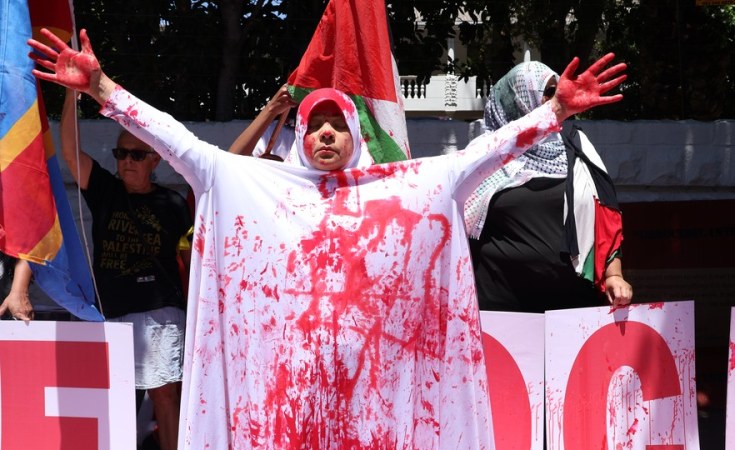
More than 1,000 people protested Sunday in the Moroccan port city of Tangier against the planned docking of a Danish vessel said to be carrying fighter jet parts to Israel. The French CGT union claims no such weapons have been found.
Dockworkers and organisations supporting Palestinians in Gaza said in separate statements that the Maersk vessel was transporting spare parts for F-35 warplanes from the United States to Israel, and was due to dock in Tangier on Sunday.
A crowd of around 1,500 people chanted, “The people want the ship banned,” and “No genocidal weapons in Moroccan waters” as they marched down a road alongside the Tanger Med container port, correspondents from the AFP news agency reported.
The accusations against Maersk followed an investigation by Declassified UK, based on cargo data it reviewed.
“Goods from US Air Force Plant 4 in Fort Worth are being transported to Haifa port in Israel on two Maersk container ships between 5 April and 1 May, and then a separate company will courier them by land to Nevatim air base”, Declassified wrote.
The Danish company denies transporting weapons or ammunition to Israel, though it has a contract with the US government and has previously acknowledged shipments that “contain military-related equipment” derived from “US-Israeli security cooperation”.
Inspections of the Nexoe Maersk’s cargo have, so far, not confirmed the presence of any weapons, according to Moroccan online media Yabiladi.
The website cited a statement by the CGT General Union of Dock Workers and Port Personnel of the Gulf of Fos: “All containers have been checked, nothing to report, no weapons, no parts” aboard the Nexoe Maersk.
An end to diplomatic ties
The protesters in Tangier also called for the severing of diplomatic relations between Morocco and Israel, which were normalised in 2020 as part of the US-led Abraham Accords.
There have been several large-scale demonstrations in Morocco demanding ties with Israel be cut since the start of its war with Hamas in the Gaza Strip in October 2023.
On 6 April several thousand people demonstrated in the capital Rabat against the conflict in the Gaza Strip.
Israel and Morocco to ‘normalize’ ties, Western Sahara will pay the price
The North African kingdom has officially called for “the immediate, complete and permanent halt to the Israeli war on Gaza”, but has not publicly discussed reversing normalisation.
The Israel-Hamas conflict began after Palestinian militants attacked communities in southern Israel on 7 October, 2023, killing 1,218 people, mostly civilians, according to an AFP tally based on official Israeli figures.
The death toll since the war erupted now stands at more than 50,000, according to the Gaza health ministry.
Turkish investments in Africa stand currently at US$10 billion
Wagdy Abdelaziz
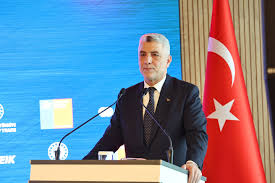
Prof. Dr. Ömer Bolat, Minister of Trade, Republic of Türkiye, has stressed that his country attaches great importance to strengthening international trade partnerships in light of the current global economic challenges.
He pointed out that Turkiye seeks to establish new frameworks of cooperation based on transparency and reducing trade barriers through multilateral dialogue initiatives, such as the Emerging Markets Forum which hold in cooperation with the Organisation for Economic Co-operation and Development (OECD) in Istanbul this April.
In statements to the Emirates News Agency (WAM) on the sidelines of AIM Congress 2025 being held in Abu Dhabi, the Minister stated that in an increasingly fragmented world, maintaining market openness has become more challenging. “The rise of protectionism, trade barriers, and geopolitical tensions threatens to undermine the global trading system. To maintain market openness, we must focus on building frameworks that promote transparency and reduce barriers to trade. This includes addressing non-tariff barriers and supporting policies that facilitate cross-border investment.”
He pointed out that Turkiye sees the need to build an environment conducive to resuming growth in global trade and investment by confronting unfair practices, stressing the importance of multilateral cooperation within frameworks such as the World Trade Organisation, UNCTAD, the Organisation for Economic Co-operation and Development (OECD) and the G20.
He further stated, “Within this understanding, we are launching a joint dialogue initiative together with the OECD hold on 10 April 2025 in İstanbul under the name of “Emerging Markets Forum”, to tackle with the issues related to the efficiency of global value chains and connectivity. We are aiming to make this Forum a regular global dialogue platform for fostering cooperation around issues of relevance for emerging economies.”
The Turkish Minister went on to say, “Since 2003, the number of Turkish commercial offices in Africa rose from 4 to 31. Secondly, it meant a completed legal framework for trade and investments with African countries. Türkiye signed “Trade and Economic Cooperation Agreement” with 50 African countries, “the Agreement on Mutual Promotion and Protection of Investments” with 31 African countries, and “the Agreement of the Prevention of the Double Taxation” with 18 African countries. Türkiye also signed the Free Trade Agreement with 5 African countries.”
He said, “At the same time, when we launched our Strategy for the continent in 2003, Türkiye-Africa trade volume was US$5.4 billion, and by 2024 it had reached US$37 billion. On the other hand, basically, there are Turkish entrepreneurs and businesses in each of the 54 countries. The total market value of Turkish investments in Africa stands currently at US$10 billion. Turkish contracting companies have so far undertaken 2.021 projects with a value of US$96.6 billion in the African continent.”
The Minister said, “In the last 20 years, our trade volume with the Middle East and Gulf countries has increased nearly 7-fold from US$8.9 billion (2003) to US$61.7 billion by the end of 2024.”
“In this framework, approximately US$14 billion of investment has been attracted from the Gulf countries to our country so far, and our trade volume with these countries has increased almost 14 times from US$2.1 billion in 2002 to US$27.7 billion in 2024.”
He noted, ” We think that the Türkiye-Gulf Cooperation Council Free Trade Agreement which is still being negotiated will significantly increase trade and economic relations between GCC and Türkiye. I would also like to remind at this point that we have already signed Free Trade Agreements with the UAE and Qatar in the past years.
“Our companies have successfully completed prestigious and large-scale projects in the Middle East and Gulf regions, which have wide financing opportunities. Approximately 2,400 projects with a total value of US$126 billion have been undertaken by our contracting companies in the region to date. Projects within the scope of the Gulf countries’ Development Visions offer significant opportunities for our contracting companies.”
Dr. Ömer Bolat said, “Our Ministry continues its efforts to channel our exporters to promising markets. In this regard, we have enacted the “Faraway Countries Strategy”. Also, with the Far Countries Strategy, the Export Development Strategy with the Members of the Organization of Islamic Cooperation, we would to increase the share of Muslim countries in our exports from 26% to 30%. With our 2025 Export Action Plan, we take more concrete steps and support our exporters in a more systematic way.
“Commercial diplomacy activities are carried out effectively and intensively in order to develop Türkiye’s commercial and economic relations and to protect our commercial interests. We have our Commercial Missions under our Embassies in 109 different countries and 161 offices and 234 Commercial Counsellors and Attaches are working in these missions to support our exporters to access new markets and help them with their needs in respective countries. ”
Wagdy Abdelaziz
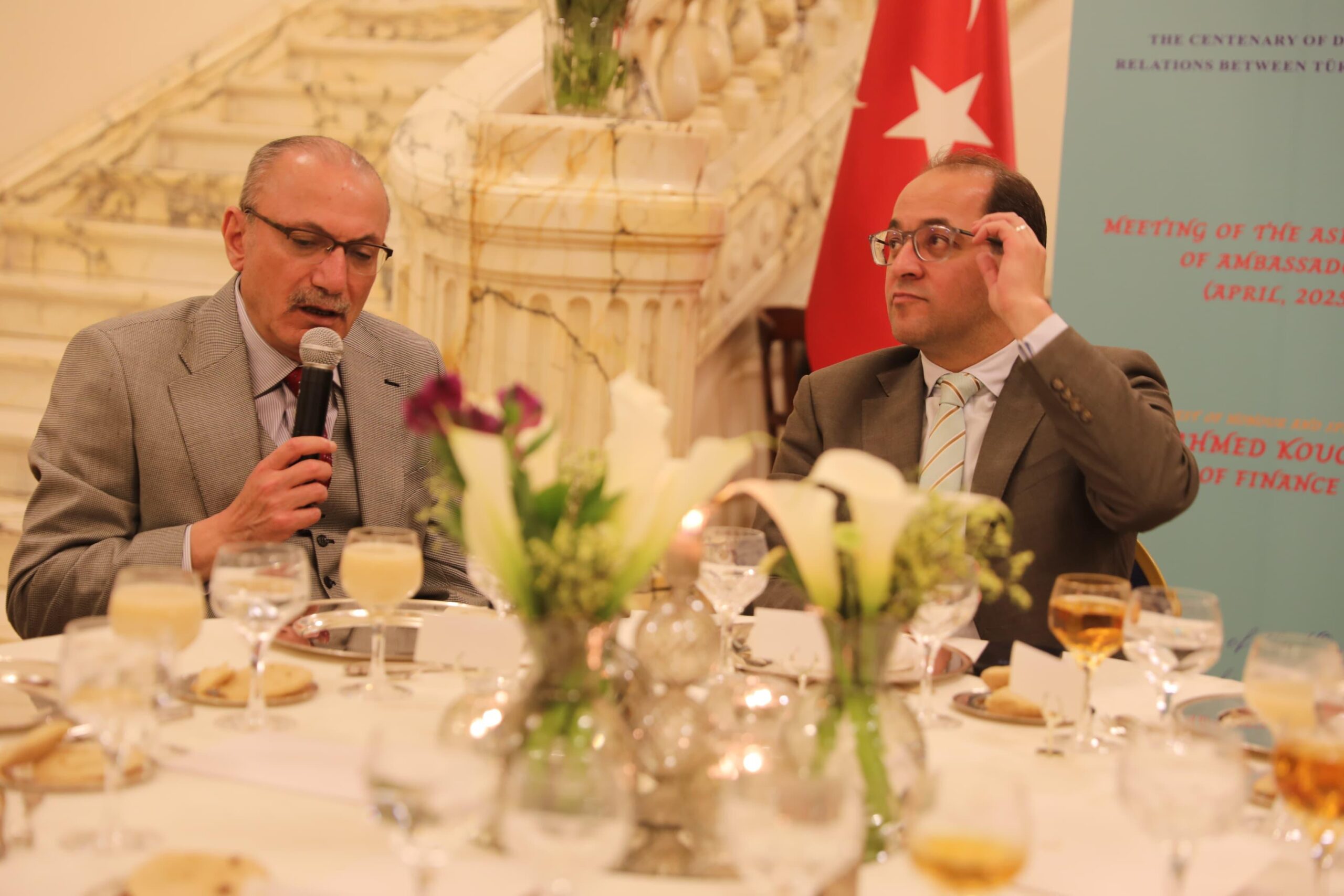
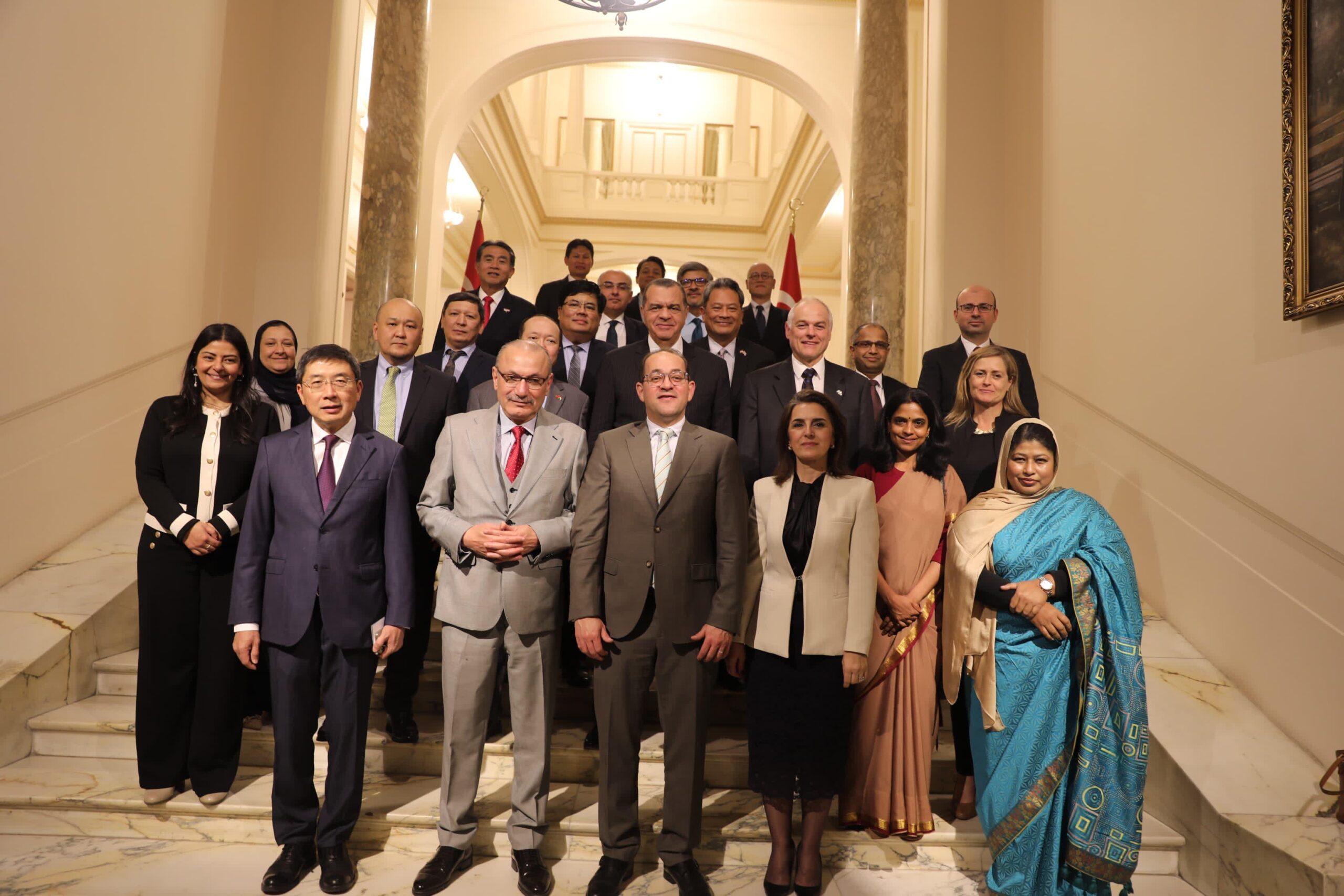
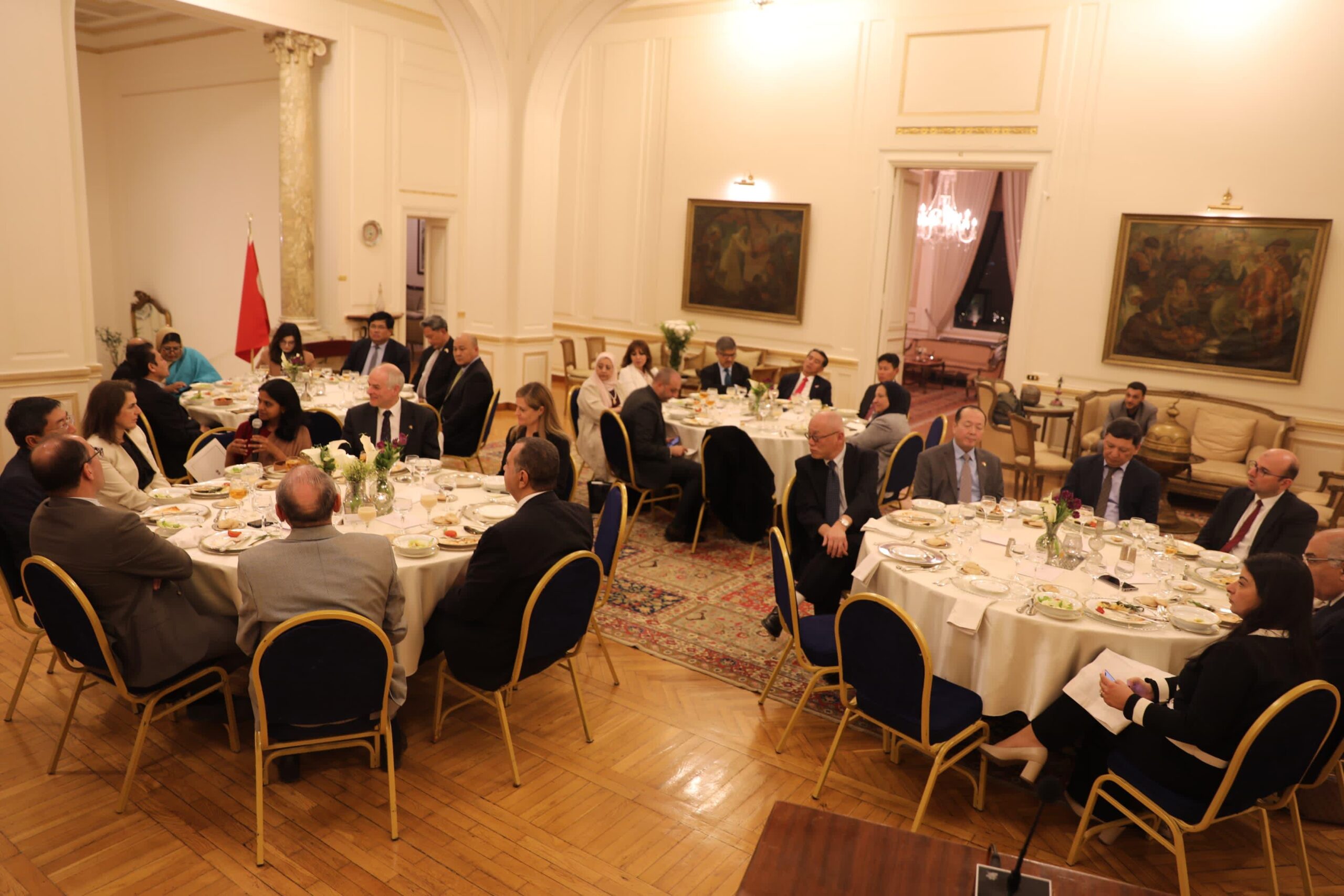
Asian Ambassadors’ Group hold a meeting at the Turkish Ambassador’s residence, with the participation of Egyptian Finance Minister Ahmed kouhk. Ambassadors from 15 Asian countries attended the meeting, with Finance Minister Ahmed Koujk serving as the guest of honor and keynote speaker.
Finance Minister Ahmed Koujk noted the recent positive developments in Egypt’s fiscal and tax policy. Koujk assured the ambassadors attending the meeting that he was ready to meet and contact the most important investors in their countries if they provided him with information about them, and that Egypt’s door was open to investors. The participating ambassadors posed questions to the Minister of Finance on various issues.
For his part, Turkish Ambassador to Cairo Salih Mutlu Şen emphasized that Egypt is a country open to trade and investment, and that Turkish investors’ interest in Egypt is growing.
He explained that Finance Minister Ahmed Koujk participation in the meeting would instill greater confidence in Turkish investors, and that he would direct investors coming to Egypt to explore potential opportunities with the Minister of Finance.
Ambassador Salih Mutlu Şen explained that the Turkish Finance Minister is scheduled to visit Egypt next June at the invitation of the Egyptian Finance Minister. On this occasion, he will attend some of the opening ceremonies and lay the foundation stone for Turkish investments in Egypt.
Egyptian Finance Minister Ahmed Koujk also confirmed that he closely monitors the work of the Turkish industrial company Polaris and appreciates its efforts, explaining that it has become a model and that the company and companies like Ged Tekstil are making significant contributions to the Egyptian economy.
10.3 Million tons of food wasted in South Africa as chefs push for sustainability
Muhamad Yehia.. Cairo
Here at FYN attention to detail is everything, not just the food on the plate, but every aspect of the business.
The restaurant in Cape Town’s city centre is the first on the African continent to be given the Sustainable Restaurant Association’s highest accolade – 3 stars for its Food Made Good Standard rating.
FYN places importance on serving food which is endemic to the Cape
The name FYN is a play on the region’s fynbos, an area of land with unique plant and animal species, fynbos itself means fine bush.
It’s also a play on the fact that it’s a fine dining restaurant.
Set menus for lunch or dinner vary between R1575 and R2175 (US$80 to US$110).
To achieve its three star sustainability rating the restaurant was assessed on its sourcing, working environment and its ecological impact
The UN says carbon emissions from food systems need to be addressed by minimising wastage, improving recycling, and sourcing local products instead of imported products.
It says food loss is largely due to South Africa’s poorly integrated food chain which generates waste in almost every phase of production.
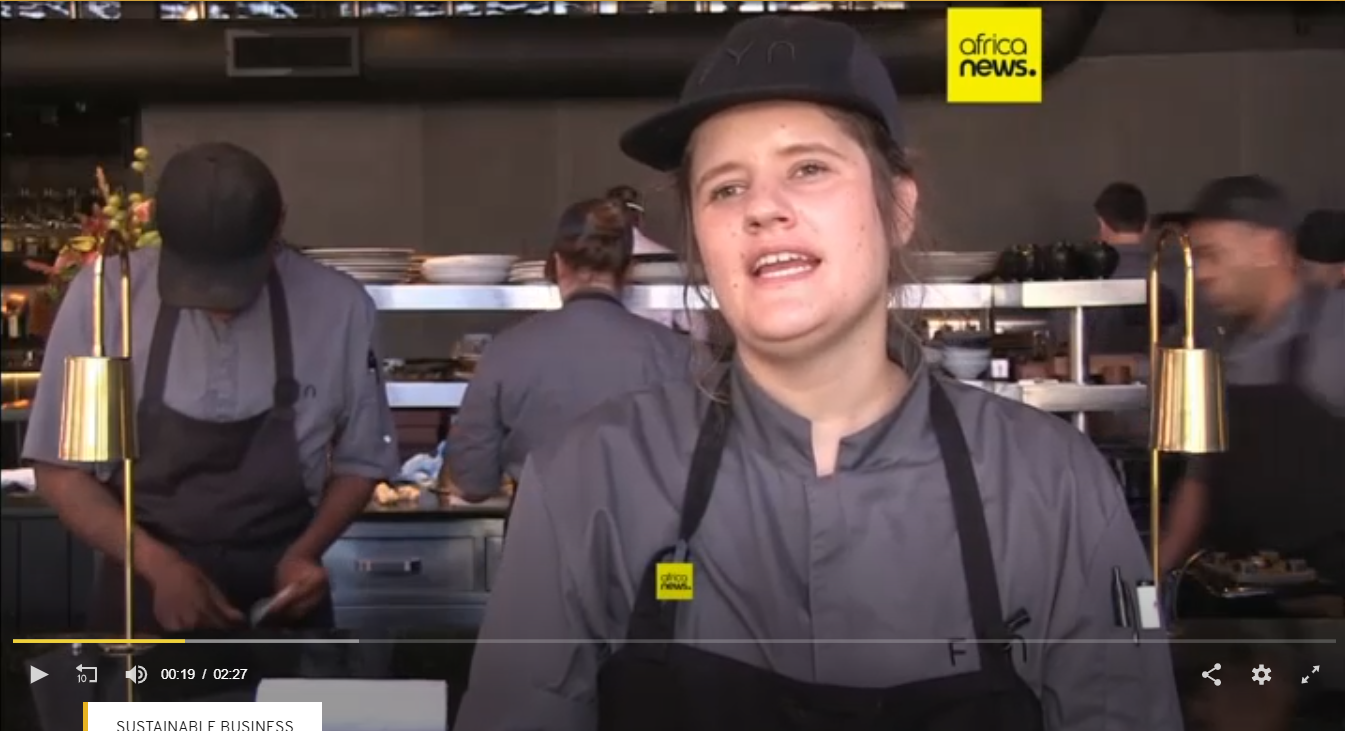
Executive Chef Bea Malherbe explains what FYN’s cuisine is a taste of the Far East using southern African ingredients.
“The food style at FYN is a mix of South African ingredients, ingredients that are true to the area whether it’s our seafood, our game, our vegetables, that we cook, and execute with a Japanese twist, using techniques that Japanese cuisine will use,” she explains.
The UN defines sustainability as meeting the needs of the present without compromising the ability of future generations to meet their own needs.
FYN sources much of its ingredients from an indigenous garden at Buitenverwachting wine estate in Cape Town.
For FYN Chef Patron Peter Templehoff, working with local ingredients offers new creative possibilities in the kitchen.
He uses local plants such as prenia in his dishes that are not typically used in cooking and claims they are undesirable by people, wildlife and pests.
He says: “Indigenes are water-wise, they’re delicious, they grow like mad in this environment. And they’re not eaten by pests and baboons, and pests, and like insects, and even humans. They’re a great source of vitamins and nutrients and it’s kind of a no-brainer to also be cooking, in particular as a restauranteur and a chef, to be cooking with something unique, unique to the region, and something I’ve never cooked with before is incredible.”
Another source of ingredients for FYN restaurant is seafood delivered regularly by non profit organisation Abalobi Fish.
Abalobi works with small-scale fishermen and provide data which verifies local catches.
The company also aims to build markets for more resilient fish stocks such as the abundant Cape Bream.
Introducing a cold chain has helped small-scale producers significantly, says Hein Goliath from Abalobi.
“What we do is to distribute cooler boxes with ice to the fishers, and that creates the opportunity for the fish to be in a better quality. And I think because we address the quality issue, it becomes a product that restaurants can offer to their customers,” he explains.
The Cape Bream here is served with persimmon, jalapeno and kosho ponzu.
Also on the menu is Outeniqua Springbok with pine nut, local miso, roasted fig and prenia.
Food critic Steve Steinfeld is visiting as a guest of FYN.
“I’m really loving the interplay between Japanese technique and then South African ingredients. It’s super clever and it’s coming through really well in the menu. I really like the soutslaai with the almost sashimi like slices of yellowtail, and when it comes to the almost nigiri to then have that with some local, aged cheese is such an unexpected yet really refreshing and interesting pairing,” he says.
Part of hitting sustainability targets in a restaurant is waste management.
Creating compost from organic waste is one measure to stop waste going to landfill site and instead be recycled.
Don’t Waste is a waste management and minimisation company which oversees FYN’s recycling.
Enya Scharein from Don’t Waste says: “Food waste is the number one problem for restaurants and food and beverage businesses. So we will help them to separate that out at source and then find solutions for it. So we’re here at Evidently Green, where FYN restaurant’s food waste comes, so that it can be composted and valorised into a valuable product.”
Arabella Parkinson is a chef who consults with lodges and restaurants to draw up sustainable food strategies. She raises two concerns with the Food Made Good Standard rating.
“There’s no transparency in terms of the questions, the questionnaire that the restaurants get for the audit to understand their practices. I think there’s always room to, you know if there was a bit more transparency maybe it would also push other institutions to try and reach for those goals, and better their practices. Then the other thing is the price point can be quite a barrier for smaller institutions. So for the medium dining or the regular restaurant, it’s very hard for them to pay for that assessment and therefore kind of keeps them out of reaching for those sustainability goals.
Parkinson nonetheless believed FYN’s three star rating is a good achievement as it shows business success needn’t be exclusive to sustainable practice.
Muhamad Yehia.. Cairo
Chinese President Xi Jinping on Friday called for stronger cooperation between his country and the European Union to resist ”bullying”.
Xi was meeting Spanish Prime Minister Pedro Sanchez who is visiting Beijing.
His remarks come as a trade war with Washington escalates, with president Donald Trump authorizing a 125% levy on Chinese exports to the United States.
“During our several meetings, we have both agreed that building China-Spain relations with strategic resolve and win-win cooperation is in the common and long-term interests of the two sides. At present, changes unseen in a century are unfolding across the world at a faster pace. Only through solidarity and coordination can countries promote global development and prosperity,” said Xi.
Spain is one of China’s closest partners in the European Union, with several Chinese companies including electric car makers announcing investments in the country.
China and Spain were both targeted in Trump’s sweeping tariffs although duties on Madrid have since been suspended.
There is no winner in a tariff war, and going against the world will only result in self-isolation, Xi said.
A booming market, but lacking data: Africa’s challenge [Business Africa]
Muhamad Yehia .. Cairo
the lack of reliable data: a major obstacle to investment and growth on the continent, the efforts of Congo-Brazzaville to strengthen its food sovereignty with Protected Agricultural Zones, and the economic crisis in the DRC, exacerbated by business closures and ongoing violence.
Without reliable data, is Africa missing out on its potential
Africa, despite its economic dynamism and the rapid growth of its middle class, faces a significant challenge: the lack of reliable data. This is a considerable barrier for investors and local businesses that struggle to make informed decisions
Bernard Laurendeau, founder of Enkopa Lab, highlights the importance of this data for decision-making in sectors such as banking, technology, and retail. According to him:
“For consumer-related sectors, you need more detailed data. The macroeconomic indicators from the World Bank or IMF can help, but it’s not enough.”
The lack of adequate data hinders strategic decision-making, particularly when it comes to investments. This situation prevents businesses from seizing opportunities, limiting their growth and innovation potential.
For Laurendeau, Africa is at a turning point. The absence of reliable data limits economic opportunities, particularly those linked to the rise of the middle class. He believes that access to real-time data could transform the continent:
“Africa is missing a big opportunity for growth, knowledge transfer, and technology because of this lack of detailed data. The key here is timely access to data.”
It’s clear that effective data management could change the game. However, he reminds us that while AI is useful, it is only a partial solution. It must be fed with accurate, up-to-date data. In partnership with Cassie Inside, Enkopa Lab is working on creating data pipelines that provide real-time insights, helping businesses make informed decisions at the right moment.
“AI is definitely not a silver bullet. It needs to be fed with data. Our partners provide data pipelines that allow real-time insights, which is crucial for fast decision-making.”
In this context, investors are becoming more demanding. Laurendeau is clear: to capture these investments, it’s not enough to provide superficial data:
“Investors want depth. They are looking for actionable information, not just general data. You can no longer ask them to be patient.”
Africa is at a decisive turning point, and collecting accurate data is becoming a strategic lever for its economic future.
Congo-Brazzaville: Protected Agricultural Zones, a response to agricultural challenges?
In Congo-Brazzaville, agriculture is crucial for diversifying the economy and reducing dependence on imports, which cost up to $1.17 billion annually. To address this, the government has launched Protected Agricultural Zones (ZAP). President Denis Sassou Nguesso stated that these zones are key to boosting local production.
In Mouindi, the ZAP brings together 500 producers across 200 hectares, while in Bouanza, 200 tons of maize were harvested on 59 hectares. Despite the abundance of arable land, only a small portion is used. If well implemented, the ZAP could reverse this trend and reduce the food import bill.
DRC: East devastated by insecurity, local businesses in crisis
Eastern DRC, particularly in the North and South Kivu provinces, is experiencing a severe economic crisis exacerbated by the violence of the M23 armed group, supported by Rwanda. The rise in violence has led to the closure of many businesses, including Bralima Brewery, a major player in the local economy, threatening thousands of jobs and worsening the shortage of essential goods. The prices of goods like rice, sugar, and oil have doubled, pushing populations into an even more precarious situation.
Economists are calling for urgent solutions, including the reopening of banks, to revive the economy. But with the ongoing attacks and deadlock in peace negotiations, the demand for concrete measures is intensifying.
Egypt says it has made “strenuous efforts” in tackling illegal migration, calls for European support
Muhamad Yehia .. Cairo
During the second ministerial meeting of the EU-Horn of Africa Migration Route Initiative, also called Khartoum Process, Egypt’s foreign minister Badr Abdelatty said that Egypt has made “strenuous efforts” to tackle migration and asked for more support from European nations.
According to Abdelatty, “no migrant boats” have left the Egyptian coast since 2016, when Egypt implemented its national migration strategy.
“We need the support of course to host communities, especially for basic services including healthcare, including education. Number three, we need more investment in order to create jobs. We have, as I mentioned, 10 million refugees living here and they have access to our labor market, they need more jobs,” Abdelatty said
“Otherwise, they would like to risk their lives and come into Europe via illegal migration through the Mediterranean. So, we have to do more to invest and to encourage for more public and private investment from European countries,” he added.
Yet the loss of funds from the American development agency, USAID, has left a hole in humanitarian aid funds for countries along the main migration route from the Horn of Africa to Europe. These include Sudan and South Sudan, Libya, Tunisia, Egypt, Ethiopia and Somalia, among others.
Katja Keul, Minister of State at the Federal Foreign Office of Germany said during the conference: “We all know USAID has been the biggest donor. The second biggest donor was Germany and I think it is no secret to tell you that the gap by USAID, we will not completely fill this gap, nobody is able to fill it. It’s a catastrophe. But we are trying to keep up our level as much as we can
Egypt currently hosts more than 9 million refugees, with most of them coming from Syria, Yemen and Sudan.
European and US markets continue to drop after Trump’s global tariffs
Global markets continue to experience sharp decline after Trump announced blanket tariffs on US imports of products from more than 180 countries and territories, ranging in severity from 10% to more than 50%
Muhamad Yehia.. Cairo
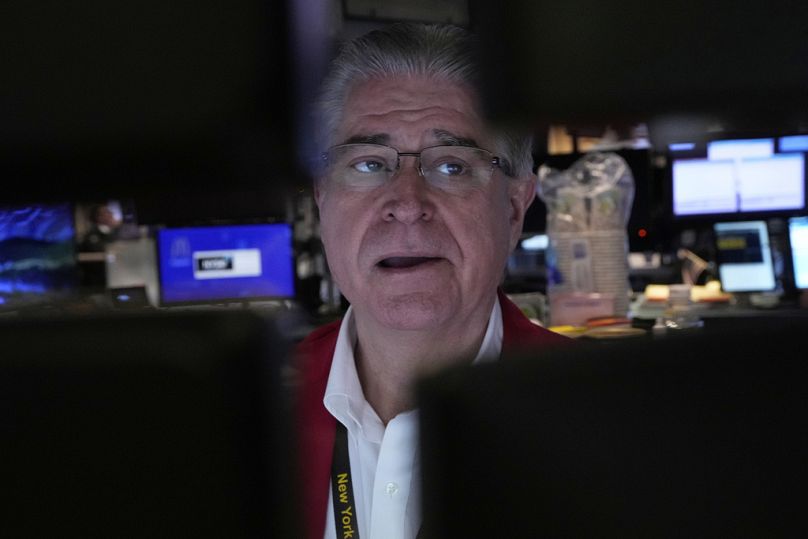
Stock markets worldwide are careening even lower Friday after China matched US President Donald Trump’s big raise in tariffs in an escalating trade war. China’s response to US tariffs caused an immediate acceleration of losses in markets worldwide.
The Commerce Ministry in Beijing said it would respond to the 34% tariffs imposed by the US on imports from China with its own 34% tariff on imports of all US products beginning April 10. The United States and China are the world’s two largest economies.
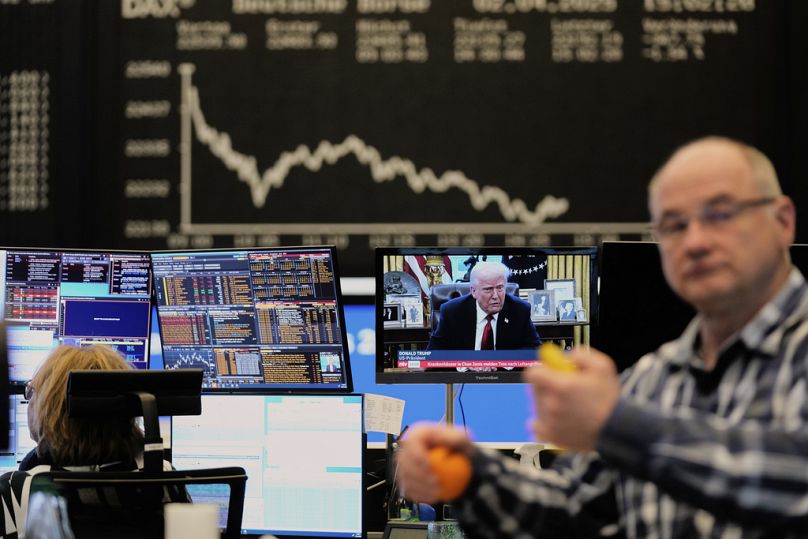
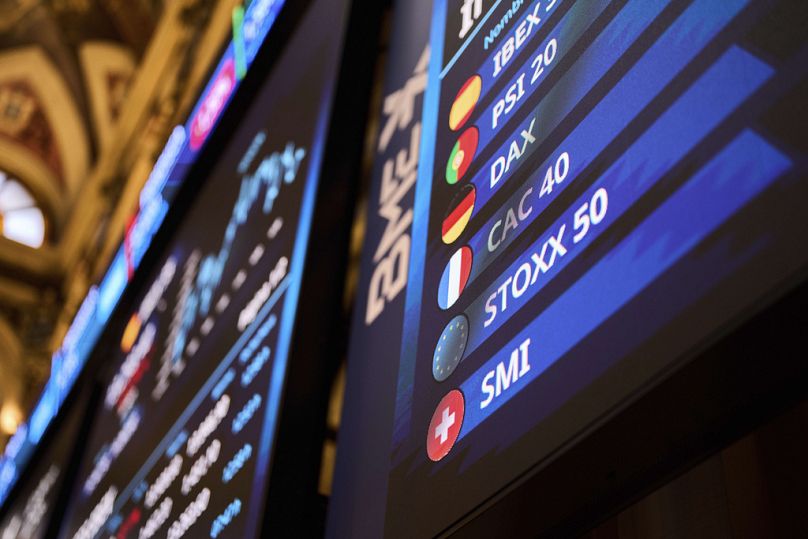
The intensified trade conflict between the US and China accelerated a slide in the German DAX index on Friday afternoon.
With a drop of more than 1,000 points, or a good 5%, to a daily low of 20,590 points, the leading German index extended its weekly decline to around 8%, according to reports of German news agency dpa

Tim Oechsner, a capital markets expert at Steubing AG, said this was emblematic of the current “high volatility”.
European stocks saw some of the day’s biggest losses, with indexes sinking roughly 5%. The price of crude oil tumbled to its lowest level since 2021.
The largest Spanish stock market, IBEX35 (IBerian-indEX) also saw a fall of roughly 5% on Friday. In the middle stretch of trading, the IBEX35 took a nosedive, bringing it down to 12,500 points, as it was also dealt a crucial blow by the US-China led tariff war
The Spanish selective index was the one that managed to weather the impact of the tariffs, which were announced on Wednesday night, in the best possible way, registering a fall of 1.2%, relatively minor in comparison with European counterparts which averaged 3%.
France similarly took a hit, with its largest market, the CAC 40 dropping about 4.3%, in what were the biggest weekly losses for European shares in years.

Leading the charge for European response, French President Emmanuel Macron urged all French companies to pause planned investments in the US.
Acting German Economy Minister, Robert Habeck, echoed the same sentiment, adding that Trump would “buckle under pressure” if Europe united together in its response
France’s Finance Minister Eric Lombard however cautioned against tit-for-tat countermeasures on Washington’s tariffs, warning that this would also rebound on European consumers.
The European Union’s trade commissioner Maros Sefcovic said he held a two-hour call with US Secretary of Commerce Howard Lutnick and US Trade Representative Jamieson Greer.
“I was clear: US tariffs are damaging, unjustified,” said Sefcovic in a post on social media platform, X. “The Eu’s committed to meaningful negotiations but also prepared to defend our interests
The weight of Trump’s aggressive tariff policy, only exacerbated by Beijing’s reciprocal response has also dealt a sizeable blow on US markets.
The S&P 500 fell 322.44 points, down to 5,074.08 – roughly 6% – closing the week at a record low since March 2020 when the coronavirus pandemic ripped through the global economy.
The Dow Jones Industrial Average plunged 2,231 points, or 5.5%, while the Nasdaq Composite tumbled 5.8% to pull more than 20% below its record set in December.
So far there have been few, if any, winners in financial markets from the trade war. Stocks for all but 14 of the 500 companies within the S&P 500 index fell Friday.
The price of crude oil tumbled to its lowest level since 2021. Other basic building blocks for economic growth, such as copper, also saw prices slide on worries the trade war will weaken the global economy.

Trump has given mixed signals on that. On Friday, he said Vietnam “wants to cut their Tariffs down to ZERO if they are able to make an agreement with the US.”
He also criticised China’s retaliation, saying on his Truth Social platform that “CHINA PLAYED IT WRONG, THEY PANICKED – THE ONE THING THEY CANNOT AFFORD TO DO!”
Trump says Americans may feel “some pain” because of tariffs, but added that the long-term goals, including getting more manufacturing jobs back to the United States, are worth it.
On Thursday, shortly after stock markets began tanking after his global tariff announcement, Trump likened the situation to a medical operation, where the US economy is the patient, hinting that things will get worse before they start to get better.
The country that President Donald Trump declared “nobody’s ever heard of” during his 4 March address to Congress has been hit with the highest U.S. tariffs in the world. Lesotho tops the list of 20 African nations upon which the White House has announced what it calls “reciprocal” tariffs, which add to the baseline imposed on every country.
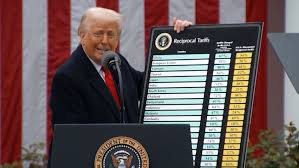
The executive order Trump signed yesterday lists levies applied to African nations, showing the worst-affected, after Lesotho’s 50 percent, are Madagascar – 47 percent; Mauritius – 40 percent; Botswana – 38 percent; Angola – 32 percent; Libya – 31 percent; and South Africa – 31 percent.
Trump announced an across-the-board additional tariff of 10 percent on most goods imported into the U.S. from Saturday, with some exceptions – the main ones being steel and aluminium articles, cars and parts already subject to certain tariffs. copper, pharmaceuticals, semi-conductors, lumber articles, bullion, energy and certain minerals not available in the United States.
The higher tariffs for 20 African nations, as well as for many other countries across the world, come into effect on Wednesday April 9.
Other African countries being levied tariffs in excess of 10 percent are:
- Algeria, 30 percent; Tunisia, 28 percent; Namibia and Cote d’Ivoire, 21 percent;
- Zimbabwe 18 percent; Malawi and Zambia, 17 percent; Mozambique 16 percent;
- Nigeria, 14 percent, Chad and Equatorial Guinea, 13 percent; Cameroon, 12 percent, and the Democratic Republic of the Congo, 11 percent.
The White House said the highest tariffs are being imposed on the countries with which the U.S. has the largest trade deficits, with the aim of boosting American manufacturing, jobs and economic security.
It claimed that “for generations, countries have taken advantage of the United States”. In one example it contended: “For decades, South Africa has imposed animal health restrictions that are not scientifically justified on U.S. pork products, permitting a very limited list of U.S. pork exports to enter South Africa.
“South Africa also heavily restricts U.S. poultry exports through high tariffs, anti-dumping duties, and unjustified animal health restrictions. These barriers have contributed to a 78% decline in U.S. poultry exports to South Africa, from $89 million in 2019 to $19 million 2024.”
Retaliation for “health restrictions” is not limited to Africa.
For example, U.S. Secretary of Commerce Howard Lutnick complained yesterday that the “European Union won’t take chicken from America…They hate our beef, because our beef is beautiful and theirs is weak” – a comment that inspired a predictable spate of caricatures and jokes on social media. The European Union has barred imports of U.S. beef under a 1989 health regulation that banned the use of growth hormones in the EU.
He said the level of the new tariffs is being set at half the rate levied on American imports by the nations concerned. But the administration’s calculations of these rates have been contested in the British media.
Listing the White House claims of tariffs charged by trading partners, The Guardian included a caveat, saying they were “Trump-defined”, included U.S. assessments of “currency manipulation and trade barriers” and “so don’t necessarily align with the tariffs published by countries concerned.”
The Sky News U.S. correspondent, Mark Stone, said the calculations were made “by very questionable White House arithmetic” and a claim that Lesotho levied U.S. imports at 99 percent was a “wild claim”.
“In fact, it’s part of a southern African trade pact with other nations which have been levied at lower levels. Lesotho’s textile industry is heavily reliant on U.S. exports. It’s a country where 56.2 percent of the population lives on less than $3.65 a day, according to the World Bank. You don’t need to ‘do the maths’ to see the impact.”
Stone added: “Nearly half of Lesotho’s exports are diamonds. Trump’s driver for all this is to bring manufacturing back home. Is his sledgehammer on Lesotho going to conjure up a diamond industry in Pennsylvania?”