By: WAgdy Abdel AZiz
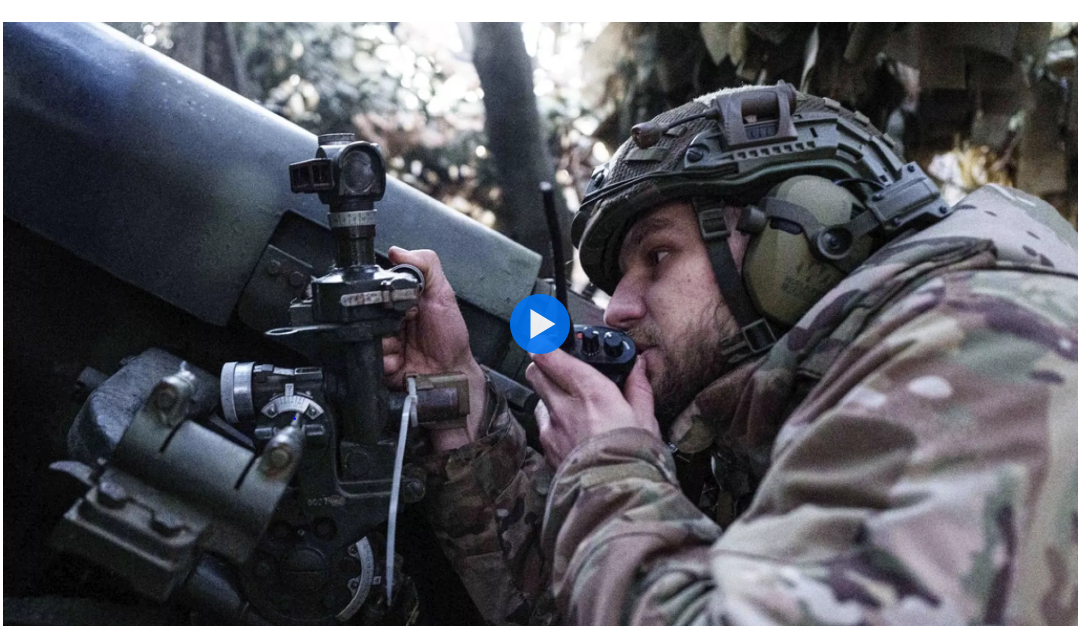
In a dramatic development reigniting tensions in Eastern Europe, the Kremlin announced today, Friday, September 12, 2025, a “temporary suspension” of communications between Russian and Ukrainian delegations in peace talks, amid mutual accusations of “lack of seriousness” from the Ukrainian side. At the same time, Russia’s Foreign Ministry revealed plans for the 13th edition of the “International Meeting of High Representatives for Security Issues” in Moscow on September 17, attended by more than 125 delegations from around 100 countries, in an effort to bolster Moscow’s influence as a global mediator amid the ongoing war since 2022. This announcement comes after weeks of military escalation, including Russian airstrikes on Poland, raising questions about whether the summit is a step toward peace or merely a diplomatic maneuver.
Talks Suspension: “Pause” Resets Eastern Front to Square One
Kremlin spokesman Dmitry Peskov confirmed in an official statement that “communications between the Russian and Ukrainian negotiating teams are currently on hold,” attributing the reason to “external interferences” from European and American countries, according to reports from Kyiv and Moscow. Peskov added that Russia remains “open to diplomatic dialogue,” but warned that “patience is wearing thin” if Kyiv continues to reject Moscow’s conditions, such as Ukraine’s neutrality and non-membership in NATO.
From its side, the Ukrainian government in Kyiv denied any responsibility for the halt, describing the Russian announcement as “a pretext for military escalation.” President Volodymyr Zelenskyy stated on X: “Russia is manipulating peace for propaganda purposes while continuing to bombard our cities.” This suspension follows the failure of previous rounds in Istanbul and Turkey, where talks stalled in March 2022 over disputes regarding Russia’s withdrawal from Donbas.
Moscow Security Summit: 100 Countries Confront the “Unipolar Order”
In a move aimed at promoting Russia as a force for multipolarity, the Russian Foreign Ministry announced that the International Meeting of High Representatives for Security Issues will bring together more than 125 delegations from approximately 100 countries, focusing on “rebuilding the global security architecture” away from “Western hegemony.” The annual event, held since 2014, will feature broad participation from African, Asian, and Latin American nations, including representatives from BRICS and the Shanghai Cooperation Organization, per ministry statements.
The agenda is expected to emphasize issues such as “regional security in Europe” and “countering terrorism,” with indirect references to the Ukraine crisis. Spokeswoman Maria Zakharova described the summit as “proof of the collapse of the Western order,” stressing that “Southern countries reject American blackmail.” However, NATO countries like Poland and France have declined participation, viewing the event as a “Kremlin propaganda platform.”
International Reactions: From Welcome to Warnings
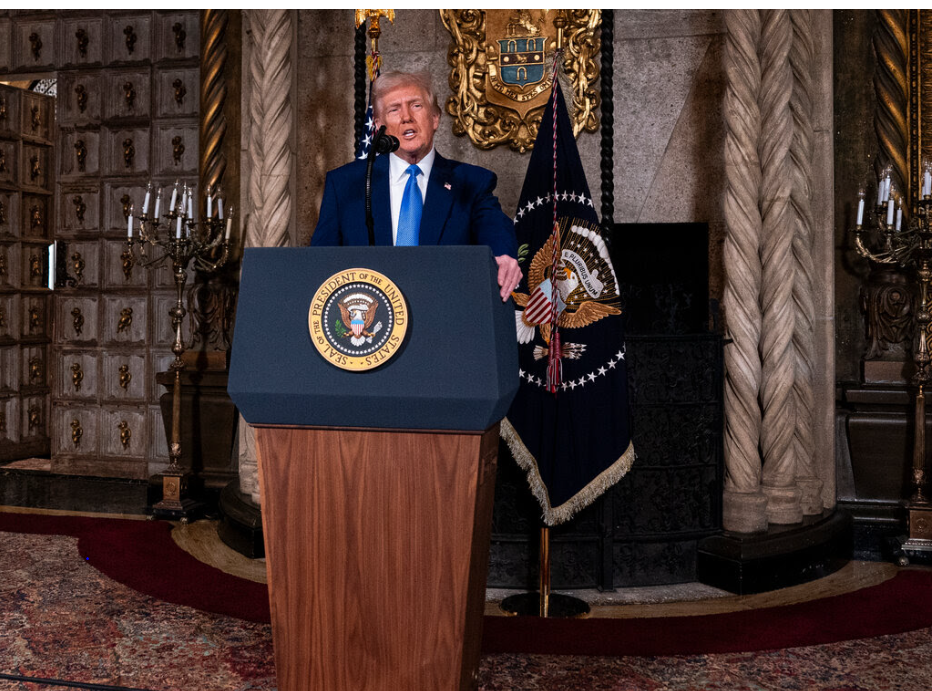
Countries like China and India welcomed the summit as an opportunity for “multilateral dialogue,” while U.S. President Donald Trump warned that “our patience with Putin is running out quickly,” alluding to the need for “military pressure” on Moscow. In Europe, French President Emmanuel Macron reaffirmed solidarity with Poland after a recent Russian raid, calling for a “decisive NATO response.”
On X, the posts sparked heated debate, with Ukrainian activists calling for an “immediate halt to the killing” and Russian accusations that “the West is obstructing peace.” Analysts see the suspension and summit as Russia’s attempt to regain the initiative ahead of winter, anticipating military escalation in Donbas.
As the summit approaches, eyes are on whether it will bridge the gap for resuming talks or serve as a show of strength.
Ukraine
Will the EU be able to save Radio Free Europe after Trump’s funding cuts?
Muhamad Yehia
European Union government ministers are discussing ways to keep the pro-democracy media outlet afloat after the Trump administration stopped its grants over the weekend.
Now that Radio Free Europe/Radio Liberty (RFE/RL) has fallen victim to sweeping funding cuts by US President Donald Trump’s administration, the future of the pro-democracy media outlet is unclear.
RFE/RL started broadcasting during the Cold War, and has played an important role reporting across Eastern Europe, Central Asia and the Middle East eve since. Its programmes are aired in 27 languages in 23 countries.
The outlet has also provided critical coverage in Ukraine, especially after Russia labelled Voice of America and Radio Free Europe “foreign agents”, adding RFE/RL to the list of “undesirable organisations” in 2024.
Ukraine to propose its own ceasefire deal in US talks in Saudi Arabia

Muhamad Yehia
Ukraine is to propose its own ceasefire deal in talks with the US in Saudi Arabia, aiming to sign the ‘Rare Earth Minerals’ deal with Washington to resume paused military aid after Zelenskyy-Trump tensions.
A Ukrainian delegation set to meet with America’s top diplomat in Saudi Arabia about ending the 3-year war with Russia.
The delegation will propose a ceasefire covering the Black Sea and long-range missile strikes, as well as the release of prisoners, two senior Ukrainian officials said on Monday.
The officials, who spoke on the condition of anonymity, also told The Associated Press that the Ukrainian delegation is ready during the talks to sign an agreement with the United States on access to Ukraine’s rare earth minerals — a deal that US President Donald Trump is keen to secure.
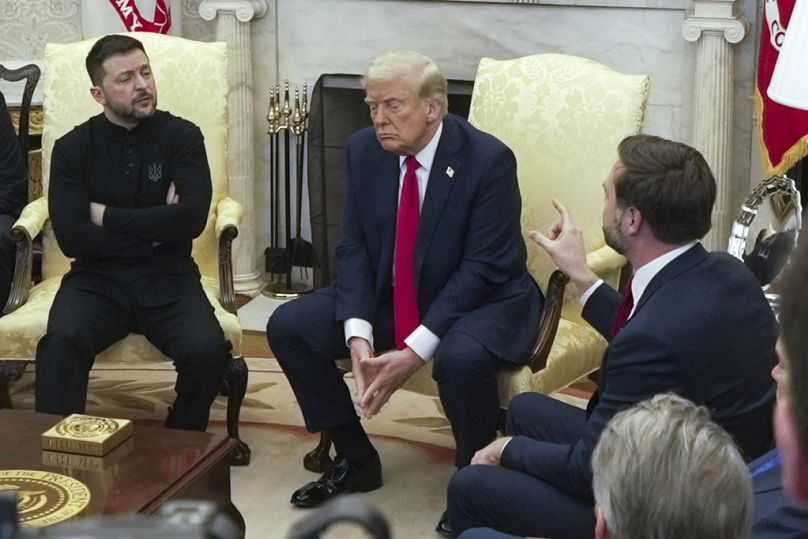
Kyiv is trying to repair the damage done when Ukraine President Volodymyr Zelenskyy’s Feb. 28 visit to Washington descended into a live on air argument in the Oval Office with Trump and Vice President JD Vanc
At stake is the military aid and intelligence previously offered by the US that had helped Ukraine in the war but is now paused as Washington pushes for a peace agreement.
Rubio and Zelenskyy landed a few hours apart Jeddah, though they were not expected to meet. Both were to meet separately with the kingdom’s powerful crown prince on Monday evening.
Speaking to reporters aboard his plane, Rubio said he and national security adviser Mike Waltz would assess Ukraine’s responses in Saudi Arabia
If Ukraine and the US reach an understanding acceptable to Trump, that could accelerate his administration’s push for peace talks.
Rubio: We will see how far apart we truly are
“What we want to know is, are they interested entering some sort of peace conversation and general outlines of the kinds of things they could consider, recognizing that it has been a costly and bloody war for the Ukrainians. They have suffered greatly, and their people have suffered greatly,” Rubio said. “And it’s hard in the aftermath of something like that to even talk about concessions, but that’s the only way this is going to end and prevent more suffering.”
He added: “I’m not going to set any conditions on what they have to or need to do. I think we want to listen to see how far they’re willing to go and then compare that to what the Russians want and see how far apart we truly are.”
Zelenskyy has said his team meeting with Rubio will include his chief of staff, Andriy Yermak, foreign minister Andriy Sybiha, and Defense Minister Rustem Umerov. Rubio will lead the U.S. team
Europe is skeptical about the talks
The rest of Europe remains skeptical about the talks as Washington has sidelined them.
Last week, the European Union agreed to boost the continent’s defences and to free up hundreds of billions of euros for security in response to the Trump administration’s shift in stance on Ukraine.
White House special envoy Steve Witkoff told Fox News on Monday that the pause in US intelligence sharing with Ukraine has not limited ‘defence intelligence’ sharing.
“We never shut off intelligence for … anything defensive that the Ukrainians need,” Witkoff said.
A pause on sharing US intelligence that can be used for offensive purposes by Ukrainian forces remains in effect, according to a US official familiar with the matter who was not authorized to comment and spoke on the condition of anonymity.
The official suggested that progress could be made toward reinstating intelligence-sharing with Ukraine during the Saudi talks.
Trump pauses US military support to Ukraine after White House spat with Zelenskyy
Muhamad Yehia
A White House official said Trump wants the Ukrainian president to commit to reaching a peace deal with Russia.
US President Donald Trump has directed a “pause” to US military assistance to Ukraine after a disastrous White House meeting as he seeks to pressure his Ukrainian counterpart Volodymyr Zelenskyy to engage in peace talks with Russia.
A White House official said Trump is focused on reaching a peace deal to end the more than three-year war which began with Russia’s all-out invasion of Ukraine, and wants Zelenskyy “committed” to that goal.
The official added that the US was “pausing and reviewing” its aid to “ensure that it is contributing to a solution.”
The pause is not believed to be a permanent end of US assistance
In the leadup to his 2024 election win, Trump vowed to quickly end the war in Ukraine. He’s expressed increasing frustration with Zelenskyy over the war, while simultaneously expressing confidence that Russian President Vladimir Putin can be trusted to keep the peace if a truce in the conflict is reached.
Earlier on Monday, Trump slammed Zelenskyy for suggesting that the end of Russia’s war against Ukraine likely “is still very, very far away”.
The comments come as prominent Trump allies escalate pressure on Zelenskyy to dramatically change his approach to the US president, who has made quickly ending the war a top priority, or step aside
The relationship between Trump and Zelenskyy has been strained following a contentious meeting at the White House, where Trump and Vice President JD Vance chastised Zelenskyy for not being sufficiently appreciative of US support for Ukraine.
In his upcoming speech before Congress, Trump is set to discuss the future of a US-Ukraine agreement involving rare earth minerals, which has now been thrown into doubt.

While he had previously refused to sign the deal with Ukraine, citing a lack of appreciation from Zelenskyy, Trump has, however, continued to describe the deal as “great”. He is expected to reveal further details during his address on Tuesday.
US Secretary of State Marco Rubio has also assured British officials that the US is committed to negotiating an end to the war, expressing gratitude for the UK’s efforts to encourage Europe to bolster its defence in a phone call with British Foreign Secretary David Lammy.
Europe rallies to Ukraine’s side as more officials reaffirm support after Trump spat
Muhamad Yehia
European officials continue to express their solidarity with Ukraine after a highly tense meeting between Trump and Zelenskyy in the White House escalated into a shouting match.
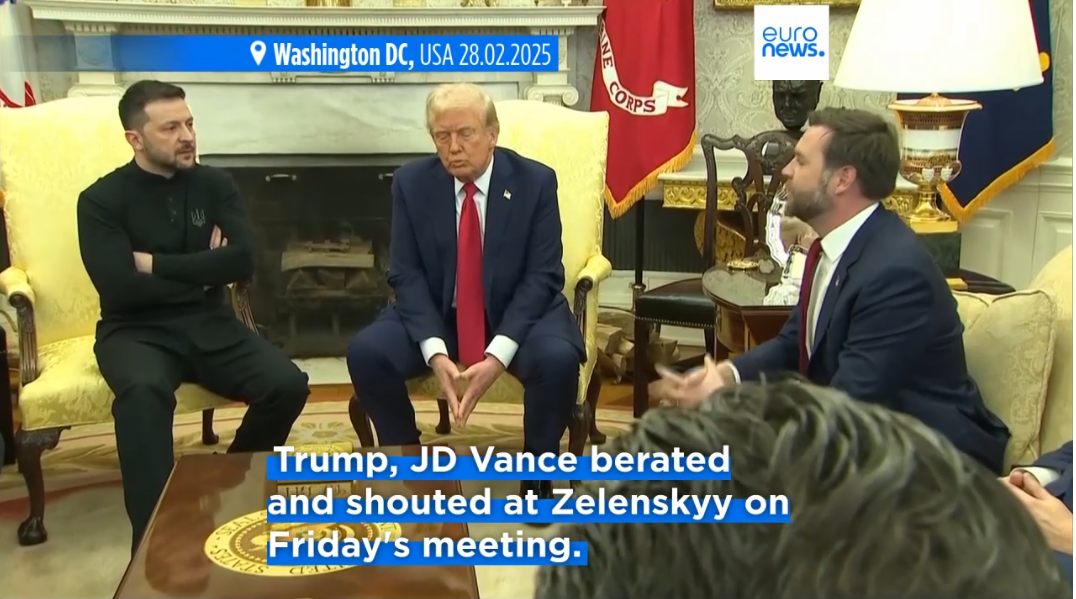
The last day of February 2025 will be remembered, very likely for decades to come following Friday’s debacle in the Oval Office, as US President Donald Trump and VP JD Vance, berated Ukraine’s Volodymyr Zelenskyy in a highly anticipated meeting.
What started out as a calm meeting later escalated, with Vance accusing Zelenskyy of being ungrateful and disrespectful to the United States, as Zelenskyy urged the US to continue standing by his country which has been fighting the Russian invasion for more than three-years.
Chaos erupted after the Ukrainian leader, responding to Vance, warned Washington that their growing support for Russia and abandonment of Ukraine will also affect them, despite the ocean that separates them from Europe.
Trump then quickly interjected, shouting at Zelenskyy telling him, “You don’t have the cards,” to dictate what can or can’t affect the US, before taunting him, arguing that without US support Ukraine would’ve been occupied in two weeks.
He also called the president ungrateful before cutting the meeting short, and reportedly instructing his officials to ask Zelenskyy to leave the White House.

In the hours that followed the dramatic incident, European leaders were quick to hurry to Ukraine’s support, expressing their solidarity and assuring a shaken Zelenskyy of continued European support for Kyiv.
The flurry of support has continued into Saturday, as more European officials continue to reaffirm their support for the eastern European country, as the world continues to process the spectacle that unfolded.
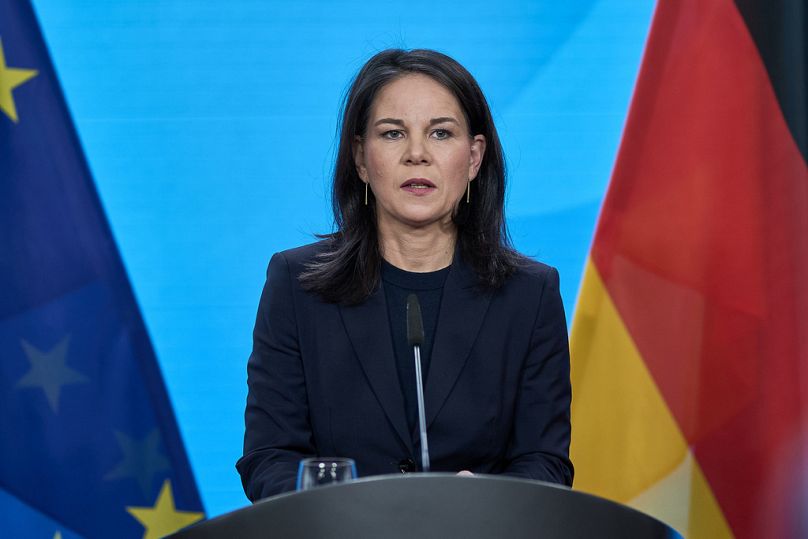
German Foreign Minister Analena Baerbock said that a “new era of nefariousness” had begun in the wake of Trump’s treatment of Zelenskyy in front of world media at the Oval Office. She also vowed that the incident will only increase German commitment to Kyiv.
“Many of you will have slept fitfully tonight in the face of the unspeakable videos from the White House. Frankly, so did I,” she said.
Baerbock underlined that the new Trump administration has cast a shadow and poses a threat on the rules-based international system, indicating an urgency to defend the order in place and uphold the strength of the law against the “might of the strongest.”

“Otherwise no free country can sleep peacefully with a stronger neighbour. All of this has been apparent for some time and that is why we have been working for some time on new, strengthened alliances with all those in the world who are prepared to continue to stand up for a rules-based international order and the strength of the law, rather than the right of the strongest.”
Her message echoed that of EU Foreign Policy chief Kaja Kallas, who said that Europeans must step up to challenge the US to lead the free world, as it had become apparent that change was needed.
Lithuania’s President Gitanas Nausėda, who expressed support for Ukraine on Saturday, later commented that he had “no doubt that the US will remain the leader in the international arena.”
Nausėda added that Europe needs to do more to keep the US’ attention not only on Ukraine, but also on the EU and NATO. He also noted that Brussels should use the upcoming NATO summit to “strength the alliance’s deterrence” capabilities.
Nausėda has not yet spoken to Zelenskyy after the White House debacle but insisted that the incident highlights the importance of maintaining dialogue and negotiations, adding that a potential peace agreement is of mutual benefit to both, Ukraine and the US.

Poland’s Defence Minister Władysław Kosiniak-Kamysz said that Trump is still a reliable ally of Warsaw’s at a press conference in Krakow, even after Friday’s events.
He emphasised that Poland will continue to cooperate with any US administration, but made clear his country’s continued support for Ukraine.
The Polish defence chief says that a return to the peace talks is in both Ukraine and Poland’s interests. He also noted that Poland can leverage its good relations with the Washington to help Kyiv return to these talks.

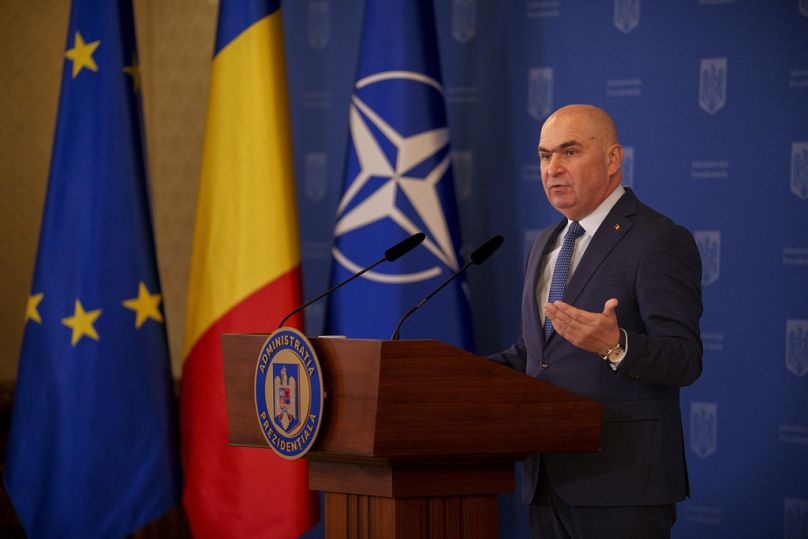
Romania’s interim President Ilie Bolojan met his Moldovan counterpart Maia Sandu in the capital Chisinau where he reaffirmed his support for Ukraine, stressing that no decision on the future of the country can be taken without Kyiv’s participation.
The two heads of states pleaded for a “lasting peace, with security guarantees, so that Russia does not have the respite to rearm and start a new war.”
Bolojan also expressed his support for Italian Prime Minister Giorgia Meloni’s idea of setting up a summit between the United Staes, Europe and allies to discuss Ukraine and other international security challenges.
Euronews reports on intensifying war in Ukraine as women take on coal mining in Donetsk
Muhamad Yehia
As the war in Ukraine enters its third year, fighting is intensifying near the city of Pokrovsk in the region of Donetsk. Euronews reports on the human impact of the conflict.
As Russia’s war in Ukraine enters its fourth year, tensions are escalating on the frontline in the country’s Donetsk region, where Ukrainian forces are engaged in a difficult battle.
There are growing fears that if Russian troops capture or bypass the city of Pokrovsk, they could advance further into the Ukraine.
Meanwhile, in the western Donbas, Ukraine’s coal mines, which are critical for the nation’s energy supply and a potential target for Moscow, are still operating — with increasing numbers of women stepping in to dig coal as men are mobilised by the armed forces.
Among the new miners is Oksana Polishyk, who found comfort and purpose both in the mines and in teaching dance to teenage girls.
Euronews International Correspondent Valerie Gauriat has prepared a moving report that gives viewers an intimate look at the human stories behind the ongoing conflict.
You can watch her coverage of those on the frontlines and the civilians whose lives have been irrevocably changed by the war on Euronews.com.
Foreign leaders arrive in Ukraine in show of support on war’s third anniversary
Muuhamad Yehia
A dozen leaders from Europe and Canada were in Ukraine’s capital Monday to show their support on the third anniversary of Russia’s full-scale invasion.
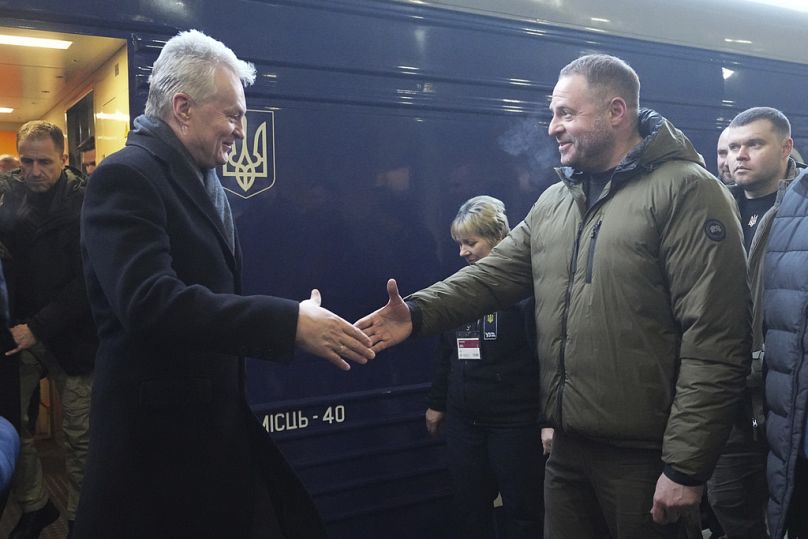
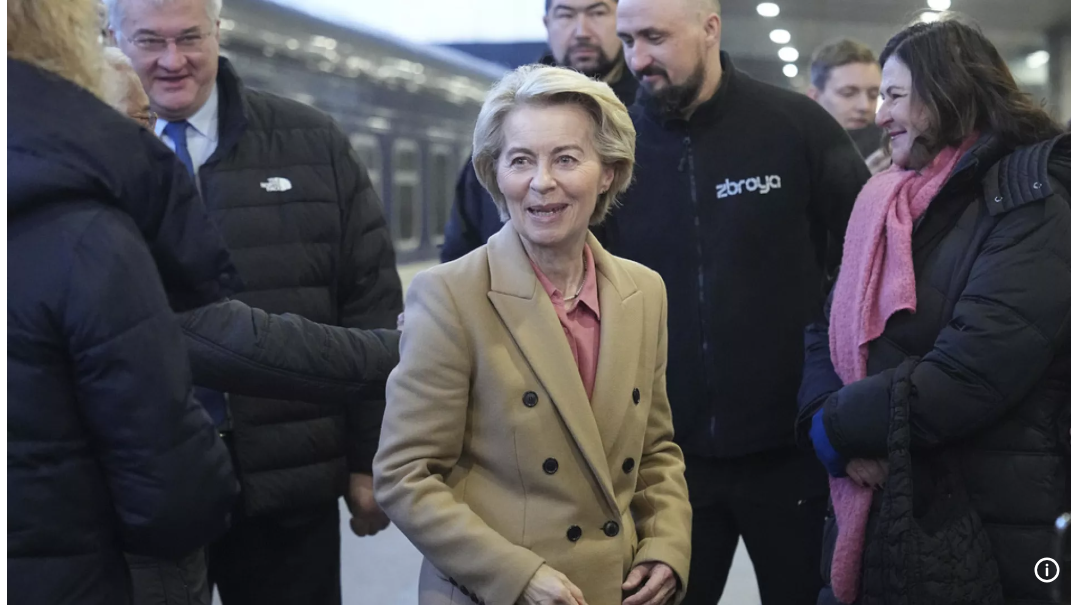
European leaders, including EU Commission President Ursula Von Der Leyen, arrived in Kyiv on Monday, to show their support on the third anniversary of Russia’s invasion full-scale invasion of Ukraine.
They and several world leaders, including Canadian Prime Minister Justin Trudeau and Spanish Prime Minister President Pedro Sánchez, were greeted at the Ukranian capital’s train station by Ukrainian Foreign Minister Andrii Sybiha and the president’s chief of staff, Andrii Yermak.
In a post on X, von der Leyen wrote that Europe was in Kyiv “because Ukraine is in Europe.”
“In this fight for survival, it is not only the destiny of Ukraine that is at stake. It’s Europe’s destiny,” she added
The leaders of the 27 European Union countries will have an emergency summit on March 6 about the next steps for Ukraine and Europe’s security. European Council President Antonio Costa announced Sunday that he will convene the summit in Brussels.
Since the EU leaders last met on 3 February, the Trump administration has upended years of US support for Ukraine and decades of commitment to defending European allies.
In a series of unwelcome developments for Kyiv, Trump has called Zelenskyy a dictator and suggested Ukraine is to blame for starting the war, while also ending Putin’s three-year diplomatic isolation by the United States
US officials, such as US Secretary of State Pete Hegseth, have indicated to Ukraine that hopes of it joining NATO and any return to its pre-2014 borders would be unrealistic.
Muhamad Yehia
European leaders are struggling to make sense of a seemingly dramatic reset of the relationship between Washington and Moscow. President Trump has been echoing talking points made by President Vladimir Putin of Russia, falsely accusing Ukraine of having provoked Russia’s invasion and casting Russia as the aggrieved party rather than the aggressor. And while Trump may not quit NATO outright, he is already undercutting it.
Yet behind closed doors, Marco Rubio, the U.S. secretary of state, has sought to reassure nervous European allies that talks with Russian negotiators this week did not represent an abrupt departure from U.S. policies as many feared. They were instead meant as a first step in a process of making a deal, he told European diplomats on a recent call.
In Ukraine, citizens still reeling from the war have been perturbed by Trump’s comments. In Bucha, a Ukrainian suburb that was the site of a notorious massacre, residents worried that they had been abandoned. “If America leaves us,” one said, “we are screwed.”
From the war: A senior Ukrainian intelligence official confirmed a plot to blow up drone goggles that was inspired by what Israeli intelligence had pulled off with exploding wireless devices and Hezbollah militants. It was unclear how much effect the scheme had on Russian forces.
US could reveal Trump’s peace plan for Ukraine as early as next week
Muhamad Yehia
US president Donald Trump’s plan to end the bloody three-year war in Ukraine could be unveiled at a security conference next week.
US President Donald Trump is expected to present a plan to end Russia’s full-scale invasion of Ukraine at the Munich Security Conference in Germany next week, according to people familiar with the matter.
Keith Kellogg, Trump’s special envoy for Ukraine and Russia, confirmed his intent to speak at the annual conference.
Since Kellogg’s revealed his plans to speak at the conference, which is held next week between February 14-16, there has been speculation that he will share Trump’s plan to end Russia’s ongoing full-scale invasion of Ukraine. Bloomberg on Wednesday quoted unidentified sources saying Kellogg would do so.
Aspects of the yet-to-be-unveiled plan could include potentially freezing the conflict, leaving parts of Ukraine occupied by Russia in limbo while providing Ukraine with assurances against Moscow attacking again
Trump has threatened Moscow with further sanctions if they don’t engage in peace talks with Kyiv. Both Russian President Vladimir Putin and Ukrainian President Volodymr Zelenskyy have indicated that previously refusal to talk to each other has changed.
Also on Wednesday, the Kremlin announced increased contact with the US discussing an end to the war. Kremlin spokesperson Dmitry Peskov said Moscow was ready to negotiate.
Zelenskyy said he would speak directly with Putin, but that the US and EU must take part.
Kellogg has also indicated a US desire for elections to be held in Ukraine once a ceasefire is reached. Zelenskyy said he is open to elections once the war ends and martial law is lifted.
Muhamad Yehia
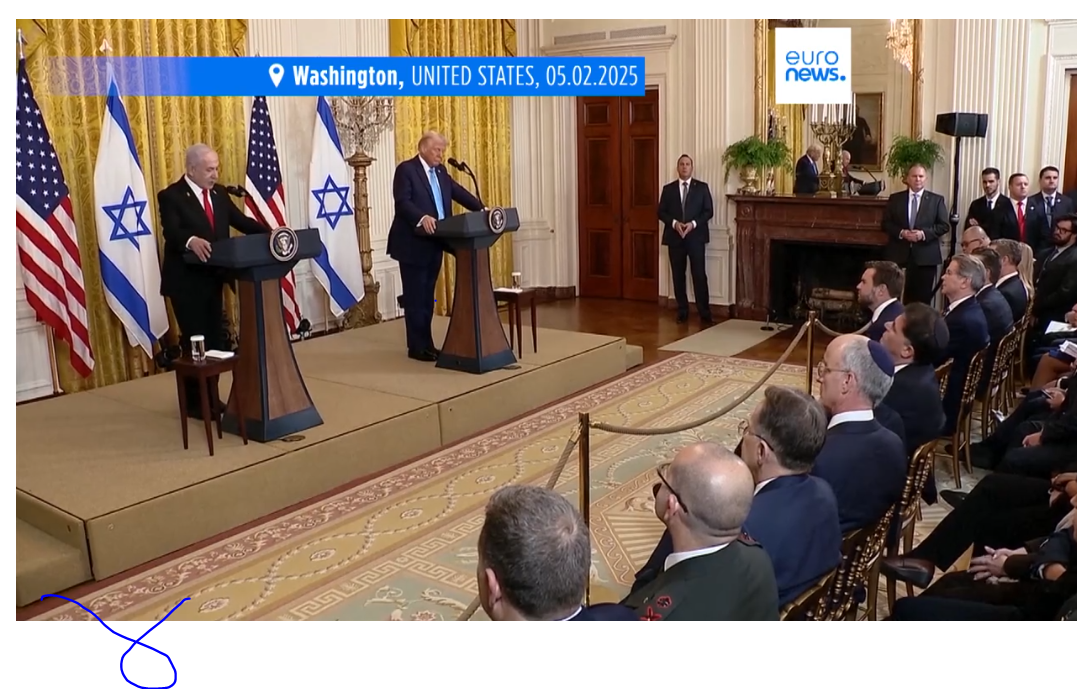
US President Donald Trump said he is committed to “buying and owning” Gaza and that other countries in the Middle East could help to rebuild it.
US President Donald Trump has doubled down on his plan to take control of Gaza, and said that he could allow other states in the Middle East to rebuild parts of the war-ravaged enclave.
“I’m committed to buying and owning Gaza. As far as us rebuilding it, we may give it to other states in the Middle East to build sections of it,” Trump told reporters onboard Air Force One as he travelled to the Super Bowl in New Orleans on Sunday.
“Other people may do it through our auspices. But we’re committed to owning it, taking it, and making sure that Hamas doesn’t move back. There’s nothing to move back into. The place is a demolition site. The remainder will be demolished,” he added.
Trump described the enclave as “the most dangerous site anywhere in the world to live in,” but said “we’ll make it into a very good site for future development by somebody
“We’ll let other countries develop parts of it. It’ll be beautiful. People can come from all over the world and live there,” he told reporters.
“But we’re going to take care of the Palestinians. We’re going to make sure they live beautifully and in harmony and in peace, and that they’re not murdered.
- Donald Trump’s plan for Gaza would ‘destabilise the Middle East as well as Europe’
- Arab Americans despair as Trump says US will ‘take over’ Gaza
The US president announced his plan to take over Gaza almost a week ago, following a meeting at the White House with Israeli Prime Minister Benjamin Netanyahu
At the time, he said that displaced Palestinians would not want to go back to Gaza. On Sunday, Trump told reporters that Arab nations would agree to take in Palestinians after speaking with him and insisted Palestinians would leave Gaza if they had a choice.
“They don’t want to return to Gaza. If we could give them a home in a safer area — the only reason they’re talking about returning to Gaza is they don’t have an alternative,” Trump said. “When they have an alternative, they don’t want to return to Gaza.”
Trump’s plan to resettle Palestinians and turn the enclave into the “Riviera of the Middle East” drew widespread international condemnation from leaders and officials worldwide.
Countries including Jordan, Saudi Arabia, France, Spain, Ireland, Germany, Türkiye, Iran, and Brazil voiced their opposition to any forced displacement. Australia, Russia and China said a two-state solution is the only way forward. UN Secretary-General António Guterres said “it is essential to avoid any form of ethnic cleansing
Palestinian President Mahmoud Abbas last week called for the United Nations to “protect the Palestinian people and their inalienable rights”, saying that what Trump wanted to do would be “a serious violation of international law”.
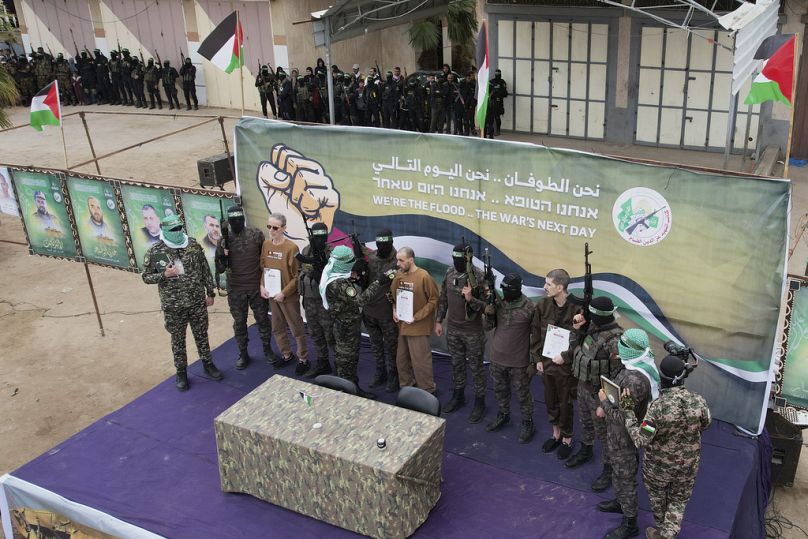
Trump also spoke on Sunday about the ceasefire between Israel and Hamas, and said he was losing his patience with the deal after seeing footage of the release of the latest three Israeli hostages by the Palestinian militant group.

“I watched the hostages come back today and they look like Holocaust survivors. They were in horrible condition. They were emaciated,” Trump told reporters.
“I don’t know how much longer we can take that … at some point we’re going to lose our patience. When I watch that, I know we have a deal where we’re supposed to get a dribble in and keep dribbling in, but they are in really bad shape,” he added.
Trump also spoke about ending Russia’s ongoing full-scale invasion of Ukraine, which he claimed would never have happened if he had been president when the war started.
“I’ve had it. Let’s just say I’ve had it. And I I expect to have many more conversations. We have to get that war ended,” he said. “Should’ve never happened, would have never happened if I was the president.”
Trump revealed on Sunday that he has already had one or more phone conversations about ending Moscow’s war in Ukraine with his Russian counterpart Vladimir Putin.