
Israel
WASHINGTON (AP) — The United States will send a T erminal High Altitude Area Defense battery to Israel, along with the troops needed to operate it, the Pentagon said Sunday, even as Iran warned Washington to keep American military forces out of Israel.
Maj. Gen. Pat Ryder, Pentagon spokesman, said in a statement that Defense Secretary Lloyd Austin authorized the deployment of the THAAD battery at the direction of President Joe Biden. He said the system will help bolster Israel’s air defenses following Iran’s ballistic missile attacks on Israel in April and October.
The delivery of the sophisticated missile defense system risks further inflaming the conflict in the Middle East despite widespread diplomatic efforts to avoid an all-out war. The Iranian warning came in a post on the social platform X long associated with Foreign Minister Abbas Araghchi, who noted the earlier reports that the U.S. was considering the deployment.
Israel is widely believed to be preparing a military response to Iran’s Oct. 1 attack when it fired roughly 180 missiles into Israel.
In a brief exchange with reporters before leaving Florida on Sunday, Biden said he agreed to deploy the THAAD battery “to defend Israel.” Biden spoke at MacDill Air Force Base in Tampa after making a quick visit to to see the damage caused by Hurricane Milton and meet with first responders, residents and local leaders.
It was not immediately clear where the THAAD battery was coming from or when it will arrive. Lt. Col. Nadav Shoshani, an Israeli army spokesman, declined to provide any timeline for its arrival, but thanked the U.S. for its support.
The U.S. deployed one of the batteries to the Middle East along with additional Patriot battalions to bolster protections for U.S. forces in the region late last year after the Oct. 7, 2023, attack on Israel by Hamas militants. Ryder also said that the U.S. sent a THAAD battery to Israel in 2019 for training.
It also is not unusual for the U.S. to have a limited number of troops in Israel, which the U.S. considers a key regional ally. There generally has been a small number of forces there consistently as well as routine rotational deployments for training and exercises.
The THAAD will add another layer to Israel’s already significant air defenses, which include separate systems designed to intercept long-range, medium-range and short-range threats. Israel recently retired its U.S.-made Patriot systems after decades of use.
According to an April report by the Congressional Research Service, the Army has seven THAAD batteries. Generally each consists of six truck-mounted launchers, 48 interceptors, radio and radar equipment and requires 95 soldiers to operate.
The THAAD is considered a complementary system to the Patriot, but it can defend a wider area. It can hit targets at ranges of 150 to 200 kilometers (93 to 124 miles), and is used to destroy short-range, medium-range and limited intermediate-range ballistic missile threats that are either inside or outside the atmosphere.
The U.S. Missile Defense Agency is responsible for developing the system, but it is operated by the Army. An eighth system has been funded and ordered and is expected to be in the field sometime next year.
Wagdy Abdelaziz
The Cuban Ambassador to Cairo, Ambassador Manuel Rubido Diaz,
participated in the meeting held at the Arab League to discuss ways to support the Palestinian cause and call for Palestine to obtain full membership in the United Nations.
Ambassador Manuel Rubido Diaz delivered a speech at the meeting, during which he stressed Cuba’s solidarity with the Palestinian people and their struggle for self-determination and to end the Israeli occupation and aggression that resulted in the killing of tens of thousands of Palestinians during its benevolent aggression on the Gaza Strip and the West Bank.
In his speech, he appreciated the coincidence of sitting next to the Palestinian Ambassador and Permanent Representative to the Arab League, and considered it a happy opportunity to share his seat with the Palestinian representative, Ambassador Muhannad Al-Aklouk.
The Cuban Ambassador said that Palestine is a friendly country to Cuba, and I do not want to talk about the historical Cuban-Palestinian relations, but they are stable and solid relations to the point that all Cubans consider the historical struggle of the Palestinian people to be a principle of Cuba’s international and foreign policy.
The Cuban Ambassador to Cairo stressed his country’s support for an independent state in Palestine within the 1967 borders, with Jerusalem as its capital. He added, “We steadfastly and firmly condemn all the attacks that have been perpetrated against the Palestinian people, not only now, but for more than 75 years of suffering, this patient, noble, hard-working, and active people.”
The Cuban ambassador to Cairo stressed the Palestinian people’s entitlement, through the statement or recommendations of the Arab League, not only to request membership in the United Nations, but also to membership in the Security Council, because Palestine, with its steadfastness and historical resistance, cannot be compared to any struggle in the world. Its struggle deserves the respect of the entire world.
The Cuban ambassador hoped that the Palestinian people would achieve their desired independence. The Cuban ambassador concluded his speech by saying, “I take this opportunity to convey to the Palestinian people the greetings of the President of Cuba and the government of my country.
Cuba supports the Palestinian people with steadfastness and firmness in their legitimate rights. We demand and strongly condemn the attacks practiced or committed by Israel against the Palestinians. Cuba is one of the countries that has severed its relations with Israel, and this confirms the depth of relations between Cuba and its support for the Palestinian people. Finally, I thank the Arab League for joining me at the historic table and sitting next to the representative of Palestine.”
DUBAI, United Arab Emirates (AP) — Iranians voted Friday in a snap election to replace the late hard-line President Ebrahim Raisi, with the race’s sole reformist candidate vowing to seek “friendly relations” with the West in an effort to energize supporters in a vote beset by apathy.
Voters face a choice between hard-line candidates and the little-known reformist Masoud Pezeshkian, a heart surgeon. As has been the case since the 1979 Islamic Revolution, women and those calling for radical change have been barred from running, while the vote itself will have no oversight from internationally recognized monitors.
The voting comes as wider tensions have gripped the Middle East over the Israel-Hamas war in the Gaza Strip. In April, Iran launched its first-ever direct attack on Israel over the war in Gaza, while militia groups that Tehran arms in the region — such as the Lebanese Hezbollah and Yemen’s Houthi rebels — are engaged in the fighting and have escalated their attacks.
Meanwhile, Iran continues to enrich uranium at near weapons-grade levels and maintains a stockpile large enough to build — should it choose to do so — several nuclear weapons.
The remarks by Pezeshkian come after he and his allies were targeted by a veiled warning from the country’s supreme leader, Ayatollah Ali Khamenei, over their outreach to the United States.
Pezeshkian’s comments, made after he cast his ballot, appeared to be aimed at boosting turnout as public apathy has grown pervasive in the Islamic Republic after years of economic woes and mass protests. He seemed to hope that invoking the possibility of Iran emerging from its isolation would motivate people otherwise disillusioned with Iranian politics. A higher turnout typically aids those like Pezeshkian in the reformist movement that seeks to change its Shiite theocracy from within.
While Iran’s 85-year-old Khamenei has the final say on all matters of state, presidents can bend the country’s policies toward confrontation or negotiation with the West. However, given the record-low turnout in recent elections, it remains unclear just how many Iranians will take part in Friday’s poll.
Pezeshkian, who voted at a hospital near the capital, Tehran, appeared to have that in mind as he responded to a journalist’s question about how Iran would interact with the West if he was president.
“God willing, we will try to have friendly relations with all countries except Israel,” the 69-year-old candidate said. Israel, long Iran’s regional archenemy, faces intense criticism across the Mideast over its grinding war in the Gaza Strip.
He also responded to a question about a renewed crackdown on women over the mandatory headscarf, or hijab, less than two years after the 2022 death of Mahsa Amini, which sparked nationwide demonstrations and violent security force response.
“No inhuman or invasive behavior should be made against our girls, daughters and mothers,” he said.
A higher turnout could boost Pezeshkian’s chances, and the candidate may have been counting on social media to spread his remarks, as all television broadcasters in the country are state-controlled and run by hard-liners. But it remains unclear if he can gain the momentum needed to draw voters to the ballot.
There have been calls for a boycott, including from imprisoned Nobel Peace Prize laureate Narges Mohammadi. Mir Hossein Mousavi, one of the leaders of the 2009 Green Movement protests who remains in house arrest, also has refused to vote with his wife, his daughter said.
There’s also been criticism that Pezeshkian represents just another government-approved candidate. One woman in a documentary on Pezeshkian aired by state TV said her generation was “moving toward the same level” of animosity with the government that Pezeshkian’s generation had in the 1979 revolution.
Analysts broadly describe the race as a three-way contest. There are two hard-liners, former nuclear negotiator Saeed Jalili and the parliament speaker, Mohammad Bagher Qalibaf. A Shiite cleric, Mostafa Pourmohammadi, also has remained in the race despite polling poorly.
Pezeshkian has aligned himself with figures such as former President Hassan Rouhani, under whose administration Tehran struck the landmark 2015 nuclear deal with world powers.
The voting began just after President Joe Biden and former President Donald Trump concluded their first televised debate for the U.S. presidential election, during which Iran came up.
Trump described Iran as “broke” under his administration and highlighted his decision to launch a 2020 drone strike that killed Revolutionary Guard Gen. Qassem Soleimani. That attack was part of a spiral of escalating tensions between America and Iran since Trump unilaterally withdrew the U.S. in 2018 from Tehran’s nuclear deal with world powers.
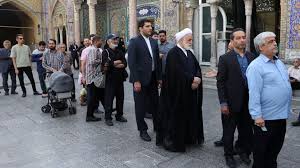
Iranian state media made a point to publish images of voters lined up in the city of Kerman near Soleimani’s grave. State television later broadcast images of polling places across the country with modest lines. Onlookers did not see significant lines at many polling centers in Tehran, reminiscent of the low turnout seen in Iran’s recent parliamentary election in March.
Khamenei cast one of the election’s first votes.
“People’s turnout with enthusiasm, and higher number of voters — this is a definite need for the Islamic Republic,” Khamenei said.
More than 61 million Iranians over the age of 18 are eligible to vote, with about 18 million of them between 18 to 30. Voting continued into Friday night as authorities extended the hours polling places stayed open, as they typically do.
Iranian law requires that a winner gets more than 50% of all votes cast. If that doesn’t happen, the race’s top two candidates will advance to a runoff a week later. There’s been only one runoff presidential election in Iran’s history, in 2005, when hard-liner Mahmoud Ahmadinejad bested former President Akbar Hashemi Rafsanjani.
The 63-year-old Raisi died in the May 19 helicopter crash that also killed the country’s foreign minister and others. He was seen as a protégé of Khamenei and a potential successor as supreme leader. Still, many knew him for his involvement in the mass executions that Iran conducted in 1988, and for his role in the bloody crackdowns on dissent that followed protests over the death of Amini, a young woman detained by police over allegedly improperly wearing the mandatory headscarf, or hijab.
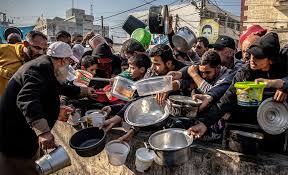
United Nations agencies warned Wednesday that over 1 million Palestinians in Gaza could experience the highest level of starvation by the middle of next month if hostilities continue.
The World Food Program and the Food and Agriculture Organization said in a joint report that hunger is worsening because of heavy restrictions on humanitarian access and the collapse of the local food system in the nearly eight-month Israel-Hamas war.
It says the situation remains dire in northern Gaza, which has been surrounded and largely isolated by Israeli troops for months. Israel recently opened land crossings in the north but they are only able to facilitate truck loads in the dozens each day for hundreds of thousands of people.
Israel’s incursion into Rafah has meanwhile severely disrupted aid operations in the south. Egypt has refused to open its Rafah crossing with Gaza since Israeli forces seized the Gaza side of it nearly a month ago, instead diverting aid to Israel’s Kerem Shalom crossing nearby.
The Israeli military says it has allowed hundreds of trucks to enter through Kerem Shalom in recent weeks, but the U.N. says it is often unable to retrieve the aid because of the security situation. It says distribution within Gaza is also severely hampered by ongoing fighting, the breakdown of law and order, and other Israeli restrictions.